

Aware, not yet prepared: Insights from a survey on societal disaster preparedness
This blog posts outlines the findings of a survey on disaster preparedness, including how communities receive information, how they prepare for potential hazards and what types of training or support would be most useful.
Between December 2025 and January 2026, we surveyed 341 people (80 practitioners and 261 members of the general public) from 20 countries across Europe and beyond, aiming to understand the current landscape of disaster preparedness, how communities receive information, how they prepare for potential hazards and what types of training or support would be most useful.
This work was carried out as part of ARTEMis (AleRT and impact-forecast standards for Emergency Management), an EU-funded research project dedicated to strengthening Europe’s preparedness and response to natural hazards in the context of climate change. Bringing together 16 partners from 10 countries, ARTEMis aims to enhance situational awareness, improve disaster response and empower stakeholders, including citizens, to achieve greater preparedness and resilience.
In this post, we focus solely on responses from members of the general public. Practitioners’ perspectives will follow in a separate piece.
Living with disasters is more common than we might assume
Before asking about preparedness, we asked about experience. The results were compelling: more than half of the general public respondents reported personally experiencing floods (51%), or earthquakes (53%), and large shares reported experiencing droughts (42%) or wildfires (39%). This is a reminder that for many people, disasters are not a distant risk. They are a lived reality.
That experience, however, does not automatically translate into preparedness. Which brings us to what people know – and don’t know – about how to protect themselves.
Experience is not a substitute for information
Despite the reported experience with hazards, the survey revealed a striking lack of knowledge about local emergency procedures, and the numbers make it hard to ignore. Only 13% of respondents said they were aware of local emergency plans or evacuation routes, and just 10% felt confident in knowing how to access assistance or shelters during a disaster. Furthermore, only 19% of respondents felt well informed by local authorities before, during, or after a hazardous event.
In practice, this means that when an emergency strikes, the vast majority of citizens may not know where to go or how to get help. When people don’t know where to go or what their municipality’s emergency plan actually looks like, preparedness remains an abstract concept, something that happens elsewhere, to others. And that disconnect has real consequences. Effective emergency response depends on trust and familiarity built long before a crisis happens, not in the middle of one, and people need to know, in concrete and practical terms, what to do and where to turn. Right now, it appears that most don’t. Closing that gap will take more than a one-off campaign; it calls for sustained, locally anchored communication that reaches people before they need it.
What stands in the way of preparedness?
We also asked what the most significant barriers to being prepared were, and responses painted a consistent picture. The most cited obstacle was a lack of awareness about local risks (57%), followed closely by a lack of training opportunities (55%). Limited engagement by local authorities or community leaders (49%) and limited time or resources (48%) came next, while 39% cited the belief that emergencies simply would not affect them.
Considered together, these barriers are insightful. The top two are fundamentally information and education problems, ones that well-designed, tailored communication and training programmes can directly address. The third barrier, limited engagement by local authorities, loops back to the disconnect we saw earlier. Even the perception that “it won’t happen to me” may itself be a symptom of poor risk communication. If people don’t receive clear, credible information about the hazards and their impacts in their area, underestimating the risk may be one of the consequences.
The opportunity is here. Let’s make good use of it
Here’s the finding that should give real grounds for optimism: citizens are genuinely willing to engage. 73% of respondents said they would like to participate in training, drills or awareness campaigns on disaster risk management and emergency preparedness.
This runs against the assumption that public engagement in emergency preparedness is a hard sell. When asked, people say yes: they want to be involved, practice, and feel capable. And this possibly represents an underused resource. Preparedness exercises and training on evacuation, first aid, and protective measures are not marginal ideas; they are what people are asking for. The challenge is making them accessible, visible and regular.
Where do people turn to for disaster information?
When it comes to finding information about risks and emergencies, clear preferences emerge. 64% of respondents said they would first turn to authorities’ websites, an encouraging sign that official sources retain public trust. But social media came in a close second (60%), ahead of television (47%), and that proximity is worth pausing on.
Social media is fast, widely used and increasingly where people turn in moments of uncertainty, but it is also fertile ground for misinformation and disinformation, particularly in the chaotic early hours of an emergency. The two findings together carry an important message for authorities: being the preferred source is not enough if the information void is being filled by rumour elsewhere. Institutions need to be not only present and credible, but also fast and proactive; they need to communicate early and clearly, and to actively counter false narratives before they take hold.
This is precisely where public warning alerts become critical. When a crisis strikes, people reach for their phones, and what they find in those first moments shapes how they respond. A timely, trustworthy alert cuts through the noise before misinformation has a chance to spread: it finds people where they are, tells them what is happening and gives them clear instructions to stay safe.
When the alert comes, it had better reach your phone
Respondents were clear about how they want it to happen. When asked about their preferred channels for receiving alerts about an imminent hazard, the answers were unambiguous: push notifications on mobile phones (69%) and SMS (67%) were by far the most popular channels, leaving others well behind: TV broadcasts (43%), social media (39%) and mobile applications (37%).
The gap between mobile alerting and everything else is significant and has clear implications. What citizens expect is an alert that requires nothing from them in advance – no download, no account to create, just a message that arrives when it matters most. Investing in robust mobile warning infrastructure is not a future priority, but an urgent one. Equally important is ensuring those alerts are clear and actionable, so that when the notification arrives, people know exactly what to do.
A few recommendations
Taken together, these findings sketch the portrait of a public that is ready and willing to engage in preparedness activities but that needs better tools, clearer information and stronger links to local institutions to do so. Based on the survey results, the project has formulated a set of recommendations for increasing citizen participation and preparedness:
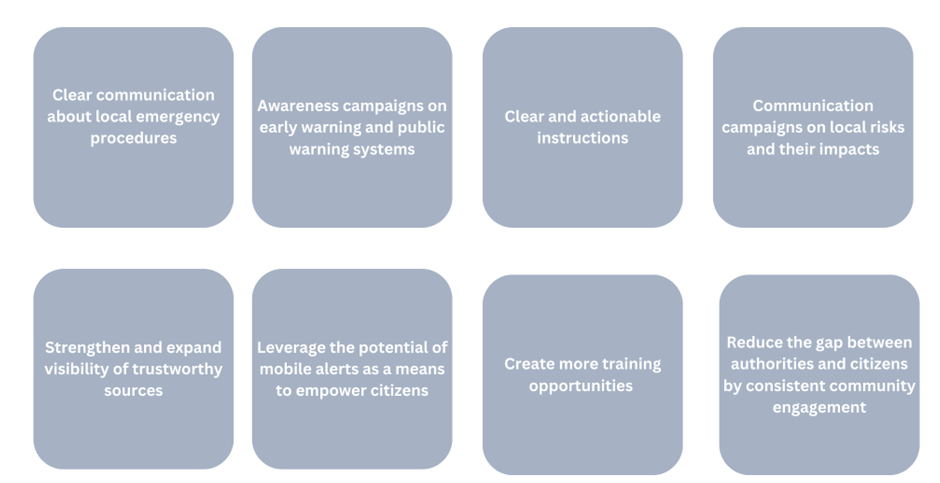
In the end, as Hadja Lahbib, European Commissioner for Humanitarian Aid and Crisis Management, mentioned in her speech at the EU Preparedness Conference earlier this year, “…preparedness is not just another policy. It is a way of thinking. Preparedness is not just about governments either. It is about people.” Commissioner Lahbib’s words resonate precisely because the data confirm them. People are not waiting to be told that preparedness matters. In many ways, they already know, and they are willing to be involved.
In our next post, we turn to practitioners and examine whether their perspective confirms, challenges, or adds nuance to what responses from the general public have revealed.
This blog post is based on survey findings from the ARTEMis project. For more information about ARTEMis, please visit artemis-horizon.eu.
This project has received funding from the Horizon Europe Framework Programme (2021-2027) under the grant agreement No 101225852.
The blog post reflects only the view of the author and the Commission is not responsible for any use that may be made of the information it contains.