


Artificial intelligence handbook: Call to action
This blogpost examines the current adoption of AI in the public safety environment, its potential evolution, impact and constraints that drive expectations. To start building a collection of cases that can help in getting familiar with the potential of AI, some real case scenarios are being addressed, showing useful applications with out-of-the-box thinking.
AI is currently being used in pretty much every environment, draining resources to a scale that was never seen before, and many times for silly purposes. But when it comes to public safety, lifesaving situations, could it be that those power-hungry algorithms can justify their existence?
I’d like to pick up the topic raised by Nick Chorley a few months ago in his blogpost and continue the discussion.
Public safety is a slow-paced world, embracing changes and new technologies much slower than the consumer world. An example? eCall was launched in 2018 based on a 3GPP standard from 2009, derived from in-band modulation. In the same year, Apple launched its 12th generation of iPhones.
Today, we want to focus on how AI is impacting the public safety world, while we are surrounded by AI bots everywhere, with an unprecedented growth rate. Is there anything preventing its adoption? If so, what?
Examples of AI applications in public safety already exist. EENA launched a call to action in 2023 to gather companies and PSAPs to test upcoming AI-based projects. Most of them concerned the application of AI to speech-to-text applications, automatic translation of text and support to decision-making procedures. These are all great examples, but the field of application seems limited, compared to what AI can already do today in other environments.
If we want to see AI power applied to public safety, we need to go beyond and search for other ways of applying AI than transforming speech-to-text or translations. Examples exist, but their adoption might be hindered by non-technological obstacles: public safety strongly relies on standardisation and procedural constraints.
On the other hand, AI is not simply one of many technological options: the potential is enormous. To leverage it today, it is essential to identify solutions to be integrated in existing platforms, rather than isolated technologies, which may prove counterproductive when considering the entire process. This means establishing the right balance between human and machine decision-making. Human in the Loop is essential to ensure the effectiveness of interventions: AI provides data and suggests solutions, but decisions must remain in human hands.
A good balance between “technological potential” and “certified procedures” consists of finding corners of application without dismantling the status quo, and seeing those applications grow in importance over time, taking their rightful space in procedures and becoming official tools, as other technologies such as CAD, GIS, etc. have done in time.
To help emergency organisations in finding these “corners”, we would like to collect use cases that are meaningful and may lead Public Safety organisations to new ideas of application. This is actually a new call to action: this blogpost is the beginning of a handbook on AI applications for PSAPs, showing how it was implemented with a positive return and how others can benefit from these experiences.
Do you think something like this would work? To share your input with us, please fill in the contact form available here: https://eena.org/contact/
Let’s take a look at the first two cases:
- Early warning: 112 PSAP in Tuscany (Italy).
Tuscany 112 has implemented an algorithm based on a Generalised Additive Models (GAM), which is used to analyse the historical pattern of emergency calls, identifies anomalies in the real time call activity and generates an early warning on those situations.
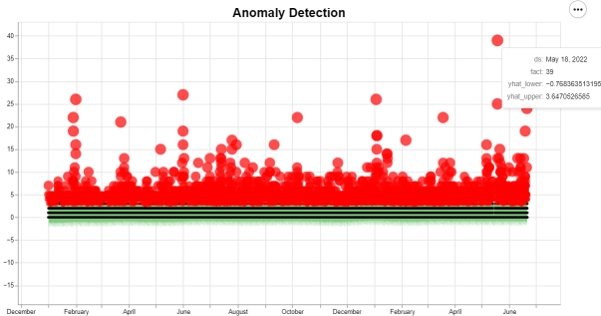
Thanks to the traditional geolocation of calls, associated with anomalies, the system is able to identify with extreme precision situations that might lead to a critical situation, if left unattended.
- Ambulance fleet management for programmed patient transportation: Ambulance service in Lombardy (Italy).
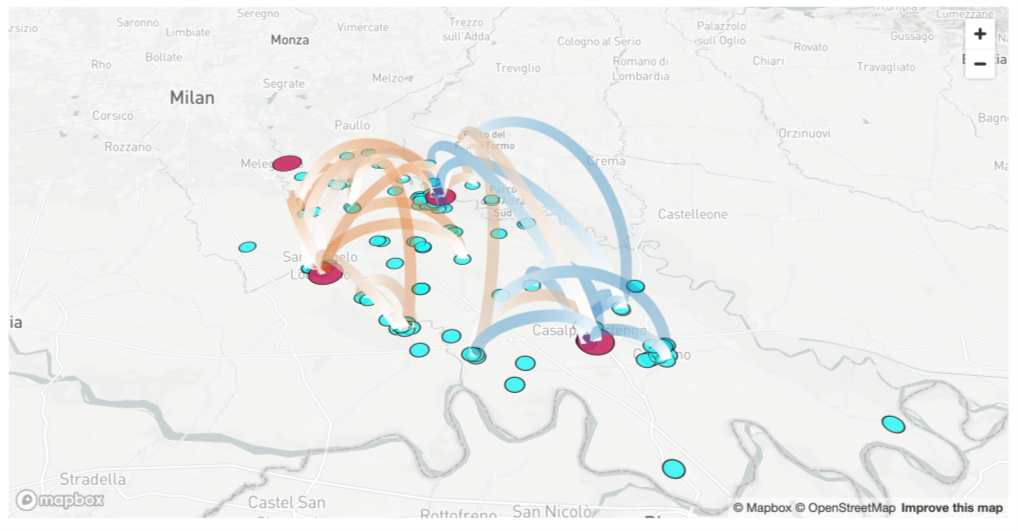
The AI solution applied at the Lombardy ambulance transportation control room is used to compute the minimal number of vehicles (by type) needed to serve trips to (and from) a list of locations. Learning on a daily basis from the programmed agenda, the AI engine makes sure to optimise scheduling of resources in all conditions.
As a result, patient transport time to hospital (and/or back home) is optimised, and ambulances become available sooner, to be either ready for another trip or to be used for emergency shifts.
- Medical coach for second opinion and training in Valle d’Aosta (Italy)
The ambulance service in Valle d’Aosta (Italy) has introduced a large language model based (LLM) virtual assistant which can determine procedures to be applied to patients, with an accuracy that surpasses all general purpose LLM tools. This “medical coach” can provide real-time opinions to physicians and paramedics while rescuing a patient, based on international guidelines and latest research validated papers. Associated with a (non-AI based) calculator of dosage for pharmaceuticals, it speeds up rescue operations and helps in diagnosis of complex cases.
The AI engine is also used for training and auditing of paramedics and physicians, simulating emergency situations, providing feedback on answers given, and helping to improve knowledge.
