


From manual routines to life-saving automation: Transforming emergency dispatch with technology
This blog post presents how Sweden’s SOS Alarm has replaced manual, repetitive tasks in the emergency dispatch process with automation to save lives.
Authors:
David Fredman, Heartrunner
Fredrik Byrsell, SOS Alarm
When a heart stops beating, there is no room for delay. And when an emergency call is made to 112, every second in the response chain must be as sharp and efficient as possible. That’s why, in recent years, SOS Alarm in Sweden has taken a decisive step: replacing manual, repetitive tasks in the emergency dispatch process with automation that saves lives.
This isn’t just a technical upgrade. It’s a new way of creating safety in society – faster, smarter, and more effective than before.
From idea to reality: Why automate
From the beginning, the goal was clear: to free up time, reduce cognitive load for ambulance dispatchers, improve precision, lower stress, and ensure that resources are dispatched with maximum accuracy as early as possible. But it was quickly realized that automation held something even greater. Every manual task eliminated created more space for the truly complex: the human craft of ambulance dispatching.
At the same time, technology opened doors to reach patients faster than ever before, and to connect systems and society in new, meaningful ways.
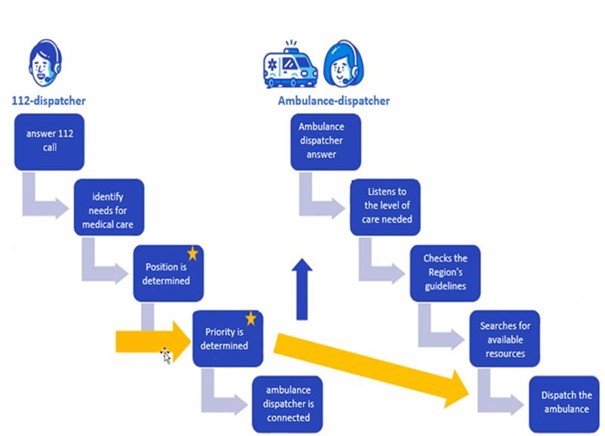
Progress over time
Since 2019, SOS Alarm have gradually built an automated dispatch platform, conducted live pilot tests, and scaled the rollout across the country. They developed robust technical systems, delivered targeted training, and maintained close dialogue with users and clients to ensure safe implementation and thorough follow-up.
Today, the majority of the most critical medical emergencies – Priority 1A cases – are dispatched completely automatically, directly after the 112 dispatcher has assessed and prioritized the event or patient.
This saves time. It improves accuracy. And it reduces the risk of error.
Automated alerts – including volunteers
One of the most impactful developments in this work has been the integration of volunteer responders – so-called “heartrunners” – into the automated alert chain in cardiac arrest.
Previously, activating these civilian heroes required manual initiation by the ambulance dispatcher. The volunteer responders are individuals in the community trained in CPR who can respond quickly to suspected cardiac arrests. In 2024, a pilot study was conducted in three Swedish regions to see if these alerts could also be sent automatically.
The result? A clear success.
The pilot showed that not only does the technology work, it significantly speeds up the response chain. In many cases, volunteer responders arrive before the ambulance and can begin life-saving efforts before professional help is on the scene. That can make all the difference when a heart stops beating.
The time gain: 11 times faster with automated dispatch
What used to take 20–30 seconds manually now happens in under two seconds, without compromising patient safety. Especially in cardiac arrest cases, automation has made a massive impact:
- Time from prioritization to dispatch has dropped dramatically.
- Time between emergency call and ambulance arrival has been significantly reduced.
Combined with the volunteer responder system, help may reach people faster than ever.
Technology frees up the human touch
The real gain is not just time, but quality. By letting technology handle the predictable and repetitive, ambulance dispatchers can focus more on the unexpected.
The benefits are clear:
- Faster help for patients
- Reduced cognitive load on ambulance dispatchers
- Fewer manual steps, reducing potential for error
- Improved compliance with protocols and response order
- Better working conditions – more time for decision-making and less for clicking
It’s a symbiosis between humans and systems, each doing what they do best.
A new standard for faster responses – with scalable solutions
The vision is clear:
- For all life-threatening cases (Priority 1A), automated dispatch should be the first and obvious choice.
- For other urgent situations (Priority 1B), automation is recommended wherever possible, considering local needs and conditions.
This is not just about technology – it’s about a new way of thinking.
A methodology that frees up resources, reduces processing times, and increases the potential to save lives.
Final words – free up time to save lives
Automated dispatch is not just a technical solution, it’s a working method that puts lifesaving first. To let automation handle what’s predictable, so the people in the chain can focus on what requires care, judgment, and human instinct.
And with volunteer responders now being dispatched automatically – sometimes even faster than anyone else – SOS Alarm have taken yet another step toward saving more lives, in less time, with greater precision.
